
J-1 in 1946 and was registered as NX48124. The "X" designating experimental or exhibition. Grumman designed and built 345 Gooses, 466 Albatrosses, and 317 Widgeons which most being in military service. Now the post war design was targeting the new era... business / executive travel. Within months the "X" was dropped because the proven amphibian was now flying around the country promoting one of the finest aircraft on the market. For nearly 3 years, Grumman used J-1 to demonstrate the performance and versatility of the new Mallard.

Grumman's introduction of the G-73 Mallard began with .
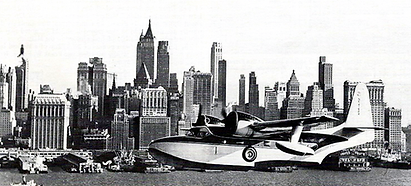.png)
photo credit Cradle of Aviation Museum, Garden City, N.Y.
J.P. Bickell of McIntyre Porcupine Mines Ltd. was the first one to step up to purchase the new Grumman amphibian taking possession of J-2 in September of 1946. Like other new owners of the Mallard, Bickell previously operated a Grumman Goose and Widgeon (the Goose s/n 1061 flew at AAB as N74550) Bickell also had brief ownership of Mallard J-16.
The first year saw sales of 26 aircraft, with the second declining to 10 and then averaged 6 over the next few years, with J-59 being the last produced on May 4, 1951. The hopes of manufacturing 250 plus was not realized. Post WWII, without military and commuter airline orders this remarkable airplane was recognized by those adventurist souls that could afford ownership. That premise still remains today.

photo credit Cradle of Aviation Museum, Garden City, N.Y.


photos Grumman Aircraft Engineering Corp from the Bill Bailey Collection

Even though the Mallard didn't see initial airline orders, (except for Air Commuting Inc., of N.Y. which never got its wings) many flew in scheduled service years later. The amphibian flew many passengers in Alaska, Canada, California, Florida and the Caribbean.


J-1
.png)
Matt's article from JOURNAL -American Aviation Historical Society - Fall 1975
There is much to be said of the Grumman G-73 Mallard and you will find an abundant amount of information on the pages of this website but the books, articles and reports by Fred Knight, Colin Smith, Matt Rodino, Fred Hotson and Geoff Goodall give detailed information regarding Grumman amphibians.
K.C. Irving was the first and only private owner of J-1. Discover more about this remarkable individual, who, like many others, chose the Mallard as their aircraft. The Mallard was not his first aircraft and certainly was not his last. Read about the man and his airplanes.


K.C. Irving with friend and business associate Lord Beaverbrook.
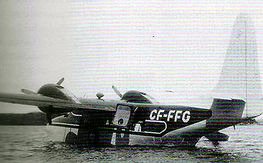
Max Aitken (Lord Beaverbrook) was the owner of Grumman Mallard J-13 CF-FFG in 1947. J-13 flew at Antilles Air Boats as N2442H.
K.C. Irving was among those welcoming Lord Beaverbrook after arriving in Irving's Douglas C-47A-75 CF-KCI in Fredericton in September 1959.

Registration CF-KCI finds a new aircraft in 1968. Irving Oil Transport takes delivery of Hawker Siddeley HS125-3A/RA
photo taken at La Guardia Airport, N.Y. by Ken Haynes

Kenneth Cole Irving was so much more than a Canadian businessman. He was considered to be an entrepreneurial
.png)
industrialist that built a business empire in the Atlantic Provinces of Canada. That empire included but certainly not limited to pulp and paper, oil refining, newspaper publishing. ship building, construction and more.
K.C. Irving was trained as a pilot with the Royal Flying Corp in Britain in 1918, so it was easy for him to recognize the importance of airplanes in business. Irving had many aircraft over the years.

Avalon Industries Ltd, a K.C. Irving company, took possession of J-1 in St. John's, Newfoundland and registered as VO-ACC on March 19, 1949. On March 31, 1949, Newfoundland officially became the 10th province of Canada and required the aircraft to be reregistered in Canada. J-1 was now CF-GPA.
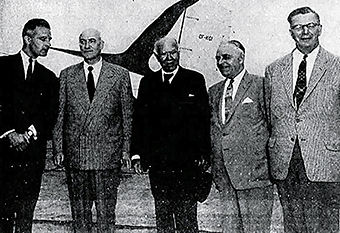
left to right: Capt. Jim Wade, Mr. Chouinard, K.C. Irving, C. LeMieux, and Mr. Plante


CF-GPA (J-1) may not have had an extended presence at Irving Oil Transport, Ltd., but it was certainly used by K.C. and his family, as well as for business activities in the Atlantic Provinces.

left to right: Capt. Jimmy Wade, Jack Irving, Mr. & Mrs. Frank J. Lang, manager of the Irving Pulp Mill, K.C. & Mrs. Irving. photo Heritage Resources

Capt. Jimmy Wade, Irving Oil Ltd. pilot in his early years
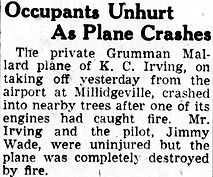
New Brunswick Telegraph Journal - 12/5/51
J-1 Ends
It was less than 3 years of operating J-1, when on December 4, 1951 the aircraft crashed immediately after takeoff. Jimmy Wade, Irving's chief pilot, recognized that the right
engine caught fire as the wheels left the runway and had little time before putting it back on the ground and into the forest ahead. The aircraft burst into flames but not before both K.C. and Jimmy walked away.
Not only did K.C. walk away but walked back to work because there was plenty to get done before
the sun goes down.
K.C. Irving owned the N.B. Telegraph Journal and bought The Daily Gleaner in 1968. He learned a little about the rewards of newspaper publishing from Lord Beaverbrook.

De Havilland Mosquito B Mark IV DK338
The Mosquito was a plywood bomber produced by De Havilland that few at 425 miles per hour at 30,000 ft. From the moment it first flew, the mosquito was the
fastest plane in the war.
By 1942 the Allies wanted the bomber, plywood or no plywood.
K.C. Irving's Canada Veneers, Ltd. provided the plywood for 6,711 aircraft producing more than 4 million square feet a week by 1943.
This was K.C.'s first meeting with
Lord Beaverbrook
( a new member of British Parliament)
but certainly not his last.

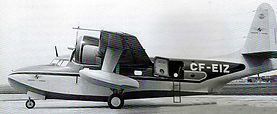
Grumman G-73 Mallard J-5 / Toronto Globe & Mail newspaper sold to Irving Oil Transport in 1953
.png)
K.C. Irving disembarks his Grumman G-44 Widgeon CF-IKH s/n 1324. Registered to Irving Oil Transport Ltd. from 1958 to 1962.


de Havilland DHC-2 Beaver CF-FHP Irving Oil Transport Ltd. registered March 1, 1952

Saint John Times Globe 6/18/52
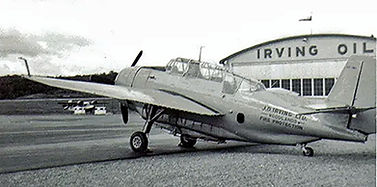
Irving Oil Hangar, Saint John, New Brunswick
J.D. Irving Ltd. TBM #508 (FIMO) June 28, 1970
photo credit Barry MacLeod.
Grumman Goose in background (still researching which Goose)

Irvine Aviation Services


.png)
.png)
My story about meeting the Irving elders...
I have been personally interested in the operations of Irving Aviation Services since its inception, as I played a role in its startup in the early 1990s. Between1988 and 1990, I led a team of aviation professionals in Gander, Newfoundland, delivering services as a Fixed-Base Operator under the name Hemmeter Aviation International. While Irving did not offer services directly, it supplied Jet-A fuel through an independent operator, Air Consolidated, which delivered Irving's product to the aircraft. At that time, Esso and Shell Oil provided the majority of Jet-A at Gander and our plan was to continue to acquire the majority of the market share of transient aircraft and provide refueling services using Irving Oil's Jet fuel.
Hemmeter Aviation's headquarters were in Honolulu, where I resided, and I often traveled to the Gander operations. During many of these trips, I also visited Irving Oil in St. John, New Brunswick, initially connecting with Bill London. He always acknowledged our increasing market share and the strengthening relationship, expressing satisfaction with our plans and interest in potential expansion. On my next visit, I was pleasantly surprised to be invited to meet K.C. and Arthur Irving, who appreciated my regular visits and recognized my focus on Gander, encouraging Hemmeter Aviation to expand our upscale services to the other Atlantic Provinces locations, especially to the movement of more Irving Oil jet-a fuel. Shortly after that meeting, Hemmeter Aviation was preparing for a sale to a Japanese company, with the understanding that I would continue overseeing all operations. I informed the Irving's, and they assured me that as long as I remained, they would too. However, shortly after the sale, I was let go. I reached out to the Irving's again to inform them of my release, and they asked if I would consider continuing independently; if not, they would proceed on their own. I declined, and they moved forward with the development of Irving Aviation Services utilizing our intended plan. I still reside in Honolulu and I will always remember those individuals that I met during those years.
.png)
Irving Oil Hangar, Saint John, New Brunswick
British Areospace BAe 125-700A s/n 257066 / 1980
Irving Oil Dassault Falcon 50
Irving Oil Dassault Falcon 50
Irving Oil Dassault 2000EX
.png)


Dassault Aircraft
photo credit Tim Lowe
photo credit unknown
photo credit Alex I
photo credit Anders Presterud
photo credit Michael Brazier
C-GJKI
C-FKCI

.png)
.png)
Bombardier Challenger
Irving Oil Gulfstream G280
Irving Oil de Havilland DHC-6 Twin Otter
photo credit Michael Durning
C-FALI

C-FKCI
photo credit Dale Hackett

C-FOCI
photo credit Christoph Plank
.jpg)
C-GJEI
photo credit Keith Holden



The incredible Journey...
The late Geoff Goodall, Fred Hotson and Matt Rodino along with Fred Knight & Colin Smith have done the hard work on documenting the history of so many amphibians. I have enjoyed taking their work and elaborate on those individuals that owned some of these iconic airplanes.
Thank you gentleman .
.png)


The above material has been produced from many sources with a number of links to additional websites. The verbiage comes from myself and others. Photos and documents have been reviewed for posting. Any questions or concerns regarding material, please contact me. Tom Anusewicz


